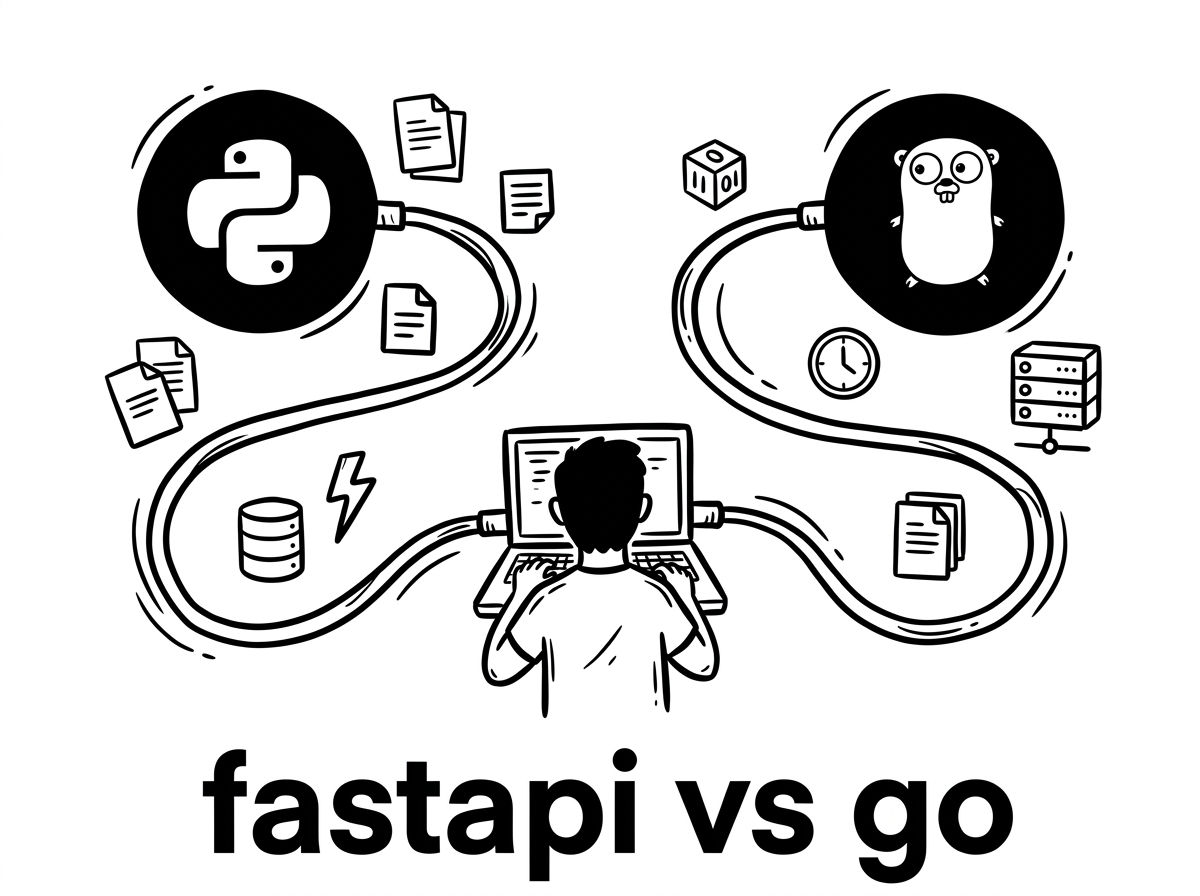
I see the same thing every few weeks.
A founder has an idea. A bit of money. A weekend. They open a tab, type “FastAPI vs Go,” and disappear for two weeks.
By the time they come back, they have benchmarks. Threads. Hot takes. A spreadsheet.
What they don’t have is an MVP.
The wrong axis
The debate almost always goes the same way.
Go is faster. FastAPI is slower. Pick fast.
Not how it works.
At MVP scale, both languages are infinitely fast. You don’t have a latency problem. You don’t have a throughput problem. You have a “no users yet” problem.
The real bottleneck of an MVP backend is not requests per second. It is the time between a messy idea and a row in a database.
What actually slows you down
The thing that kills MVPs is not the language runtime. It is:
- A schema you can’t change without three migrations
- A model that no longer matches the request body
- Background jobs you can’t debug because the logs are spread across five files
- A library you need today that does not exist in the ecosystem you picked
None of that is solved by picking the faster language. All of it is solved by picking the language you can move fastest in.
When FastAPI wins
FastAPI wins when the spec is still moving.
When you don’t fully know the request shape yet. When the schema will change three more times before the first paying user. When you need a library for “that one weird thing” and the Python ecosystem already has six.
- Pydantic absorbs schema change without ceremony
- A new endpoint is a function and a decorator
- Type hints give you enough safety without slowing you down
- Almost every third-party API has a Python client already
The trade is real. It is slower per request. The deploy is heavier. The typing is looser than Go. At five users, none of that matters.
When Go wins
Sometimes the shape of the system is already known.
You are building a webhook receiver. A pricing engine. A stream processor. The contract is fixed. The data is clean. The latency budget is real.
That is where Go starts to pay back.
- One binary, one deploy
- Predictable memory
- A concurrency model that does not fight you
- Boring code six months from now
For MVPs that look more like infrastructure than products, Go is my default.
The actual rule
Pick the language you can write in at 2am with a half-broken schema.
For me, that is FastAPI when the data is messy and the spec is moving. Go when the spec is clean and the request shape is final.
Most MVPs are the first one.
The move
Stop benchmarking. Start shipping.
Write the smallest endpoint that proves the idea. Read your own code a week later. If you can change it in five minutes, you picked right.
If you can’t, the language was never the problem.
***
If you are stuck choosing a backend for your MVP, contact me. I build MVP backends in both FastAPI and Go, and I will help you pick the one that fits your idea, not the benchmarks.